Thursday, 16 June 2016

RJ's Wonderful Writing - The Crash


The lights from the ambulance  lit up. Suddenly there was a big crash. I looked up. All the cars driving past the ambulance braked.
  The car  crumpled. On  the motorway some cars piled up. the wheels skidded and screeched. There were Injuries on people everyone was looking the windows were smashed and the bumper was taken off.  The car slammed into the wall and smashed.It was foggy. The people from the ambulance hopped out.They checked if the man was OK. 
The oil was pouring out. It was greasy. All the cars were beeping at the ambulance.

Heaps of big trucks were going past. The person was scared and confused. The wheels of the smashed car were popped. The other lights from the cars was shining. One of the  wheels rolled off the  car.  It was windy. The person was cold in the wind. We had to stop and when  the sign said “go” we drove past. They moved the car onto the truck  and while they were moving  the car the ambulance drove off and the person went to hospital.  


By RJ 

Monday, 6 June 2016

Mr Brown's Visit

Today Mr Brown from Kamo Intermediate came to Pod7 / our class to talk to us about being a flight attendant.

We learnt that there is a big inflatable slide at the door of the plane.
We also learnt that there are all kinds of jobs such as: keeping people safe, serving food and drinks, checking that passengers seat belts are on, and lastly all places on board are spotless.

We learnt where the flight attendants slept, and what part of the plane they sleep in.
He also told us where the exits and engines are. 

Mr Brown answered all our questions, and also showed us some photos of where he had travelled over the past years. 
As you get higher the oxygen level in the atmosphere goes down. 
And if you put a glass of water outside it turns to ice instantly. 

         by Dillan and Ruby. 
WACKY   HAIR  DAY

Check out our wacky hair!
We brought a gold coin donation to help raise funds for our 
school wetland project.
It was fun to see all the creative hairstyles!


W
Pod 7's Flight Inquiry Study

For our inquiry about flight, we first did a class brainstorm, where we shared all the words we knew about flight.

We then took all the different words and sorted  them into different categories.
This was quite tricky, because some words could fit into more than one category.

We then had to decide on a heading for each category, which was our Key Concept.


Our key concepts were:

Creatures that fly   
Mechanical flying machines
Objects that float in the air
Space Flight
Features of aircraft
Elements of Nature that affect flight
Flight personnel
Features of an airport
Commercial Airlines
Fantasy Fliers (mythical creatures)

Next we learnt about how to ask effective questions to help us learn more about what we wanted to find out.

Here are some of the interesting questions that
 we would like to know the answers to:

How is flying a plane different to driving a car?
What are jet engines made of, and how do they work?
How do planes fly?
What are some of the important things that a pilot needs to do when they fly a plane?
How do you control a hang glider?
How does helium help things to float in the air?
What are some of the earliest flying creatures?
How many people were on a space shuttle crew, and what jobs did they do?
What was the first plane like?
Who was the first person to fly in NZ, and where?
Who were the first people to accomplish powered flight?
When were the first fighter planes used, and what kind were they?
How does a big jet airliner start?
What are some of the different jobs that flight attendants do on domestic and international flights?

We talked about the different ways that we can find answers to these questions. Broadening our horizons to learn the "Google" is NOT the only way, has been new learning for many of us.

So far, we have found out that asking people who do these jobs can help us to learn more, because we can ask them more questions when we are face to face.
We have also discovered that photographs, newspaper articles and even songs can help us to learn more.

We are looking forward to sharing some of our findings with you via our blog.
Also, if you know of anyone who could help us with our study, please contact us, in Pod 7.


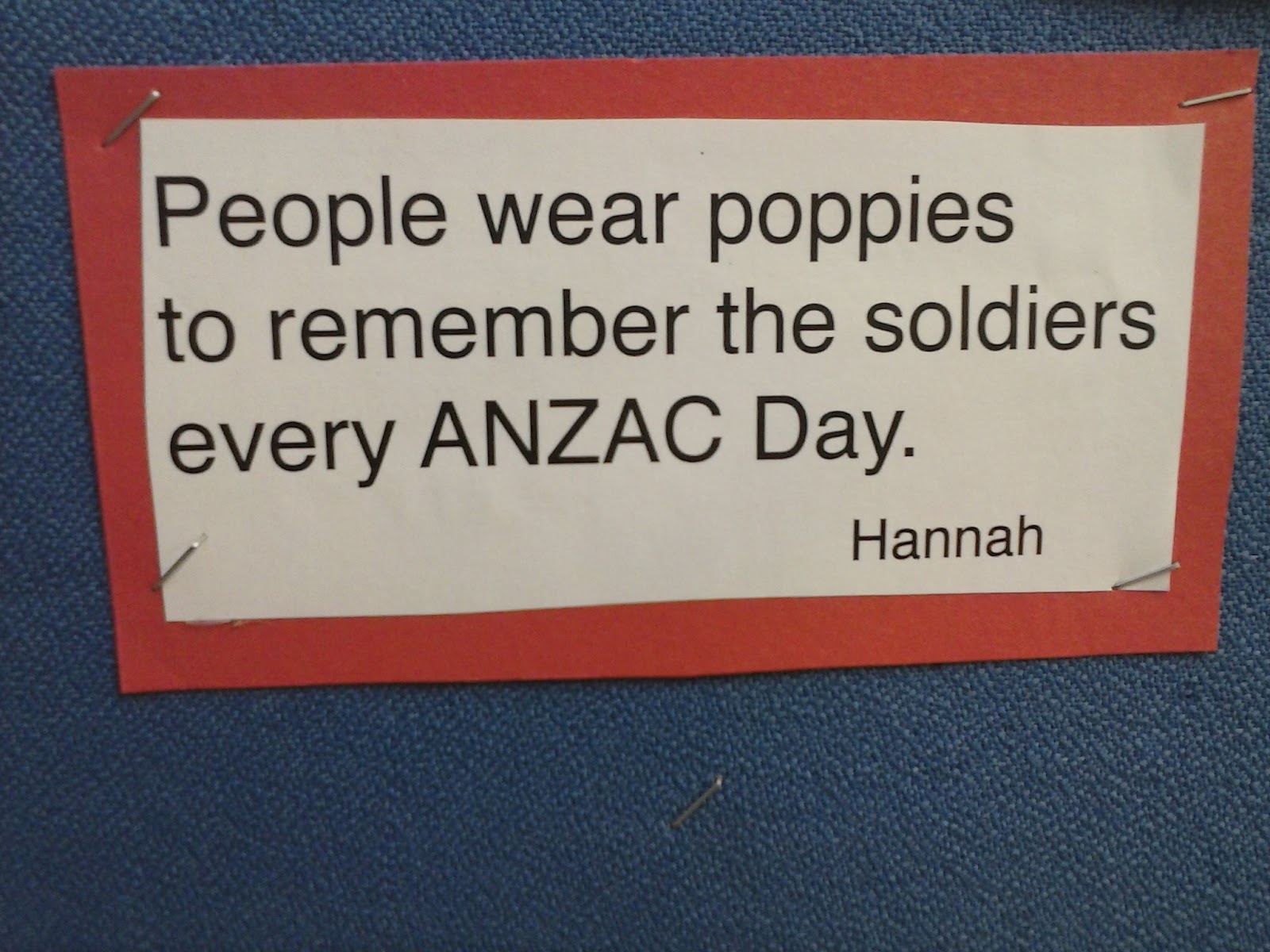
ANZAC  HAIKU

As part of our ANZAC study, we learnt how to write haiku.
They are 3 lined poems which have a 5-7-5 pattern of syllables

The first line has 5 syllables
The second line has 7 syllables
The  third line has 5 syllables

We had to think very carefully to keep our messages short and powerful.
What do you think of our efforts?


ANZAC  Poppy   Art

We used charcoal and pastels on our artwork of ANZAC  poppies. They have made an effective display in Pod 7


We have been practising our new school karakia every morning.

Here is a copy for you to practise at home.

Morning Karakia

Kia hora,  te marino
May peace  be widespread
Kia whakapapa, pounamu te moana
May the sea be like greenstone
Hei huarahi, ma tatou, i te rangi nei
A pathway for us all this day
Aroha atu, aroha mai
Give love,    receive love
Tatou i a,  tatou katoa
let us show respect  for each other

Amine